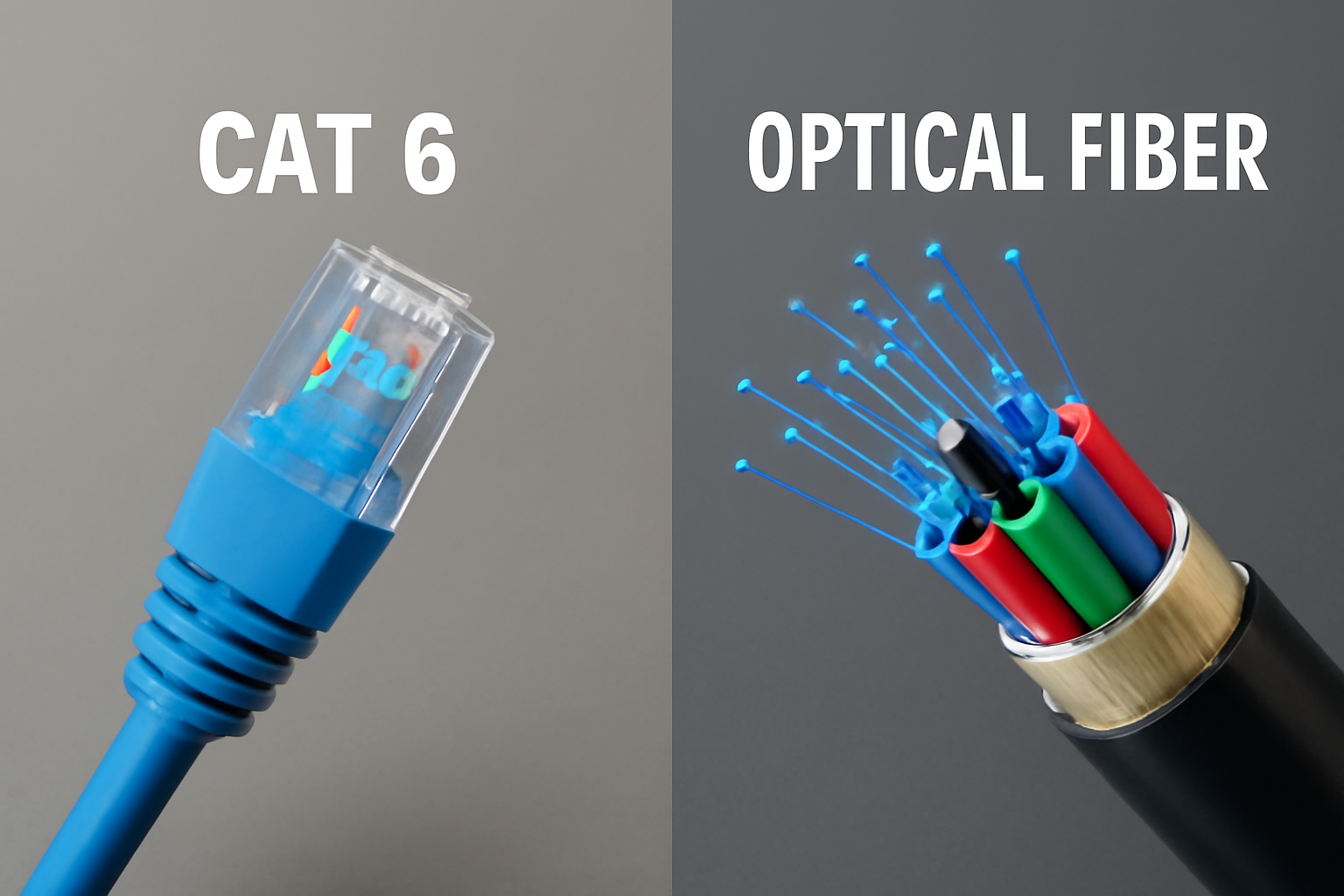
Understanding the Difference Between Cat 6 and Optical Fiber: Why Optical Fiber is the Future in Dhaka
In today’s world, reliable and high-speed internet is essential for businesses, homes, and education systems alike. With the growing demand for faster internet connections, understanding the difference between network cables like Cat 6 and Optical Fiber is crucial. But what makes Optical Fiber the preferred choice in cities like Dhaka?
What is Cat 6?
Cat 6 (Category 6) is a type of twisted pair cable widely used for Ethernet networks. It is designed for transmitting data at high speeds over short to medium distances. Here are some key characteristics of Cat 6:
- Speed and Bandwidth: Cat 6 cables can support speeds up to 10 Gbps (Gigabits per second) over short distances (usually up to 55 meters). It is ideal for home and small office networks that do not require extremely high-speed data transmission.
- Structure: Cat 6 cables consist of four twisted pairs of copper wire. These wires help to reduce electromagnetic interference and allow for high-speed data transmission.
- Cost: Cat 6 cables are generally cheaper to install than fiber optics, making them a popular choice for more budget-conscious consumers and businesses.
What is Optical Fiber?
Optical Fiber cables, on the other hand, use light signals to transmit data. These cables are made up of thin strands of glass or plastic that carry signals in the form of light pulses. Optical fiber is revolutionizing the way data is transmitted over long distances with speed and efficiency. Here are its key characteristics:
- Speed and Bandwidth: Optical fiber cables offer much higher speeds than Cat 6, with the ability to support speeds well over 100 Gbps (and beyond). This makes them ideal for large-scale, high-demand applications like internet backbones and long-distance communication.
- Distance: Unlike Cat 6, which begins to lose speed over longer distances, optical fiber can transmit data over much greater distances (up to several kilometers) without signal degradation, making it more suitable for large organizations or city-wide infrastructure.
- Signal Integrity: Optical fiber is not susceptible to electromagnetic interference (EMI), which is a common issue for copper-based cables like Cat 6. This makes fiber-optic connections more stable and secure.
- Cost: Optical fiber is more expensive to install, but its long-term benefits, such as faster speeds, higher reliability, and scalability, often outweigh the initial cost.
Why Optical Fiber is the Future of Connectivity in Dhaka
Dhaka, the capital city of Bangladesh, has seen a rapid rise in internet and data usage, both in terms of personal and professional requirements. As demand for high-speed internet continues to increase, it is becoming clear that Optical Fiber is the way forward. Here are some reasons why optical fiber is taking the lead in Dhaka:
- Demand for High-Speed Internet: As more people work remotely, stream videos in 4K, and use cloud-based applications, the need for fast and stable internet is at an all-time high. Optical Fiber offers the speed and bandwidth required to support these activities without interruption.
- Growing Smart City Infrastructure: Dhaka is rapidly becoming a smart city, with more businesses, schools, and governmental institutions requiring reliable internet connectivity. Fiber optic cables are the backbone of any smart city, enabling things like IoT (Internet of Things) devices, smart traffic management, and large-scale data processing.
- Long-Term Investment: Although optical fiber may cost more to install, it provides a long-term solution that can accommodate future growth. As the demand for data and internet speed increases, fiber networks will be able to meet these needs for years to come, making them a smart investment for both businesses and residents.
- Improved Stability: With fiber optic cables not being prone to interference, businesses in Dhaka are able to experience fewer network disruptions, which can be detrimental to operations, especially for industries like e-commerce, finance, and telecommunications.
- Environmental Benefits: Fiber-optic technology is more energy-efficient than traditional copper cables. This makes it a more sustainable option for Dhaka as it continues to expand its digital infrastructure.
Why Cat 6 Still Has a Role to Play
While optical fiber is the future, Cat 6 still has a place in specific scenarios. For smaller networks or homes, Cat 6 is often sufficient for tasks such as browsing the web, streaming HD videos, and online gaming.
Conclusion
The battle between Cat 6 and Optical Fiber is not about one being better than the other but about choosing the right solution for the right context. For Dhaka, with its expanding technological needs and growing demand for high-speed internet, Optical Fiber is undoubtedly the best choice for the future. Whether for businesses, smart cities, or personal homes, fiber optic connections offer the speed, reliability, and scalability needed to meet the demands of today and beyond.
As the city continues to evolve and adapt to digital transformations, Optical Fiber will undoubtedly play a central role in shaping Dhaka’s connectivity landscape for years to come.
More info please visit: https://ccnnetwork.net/server/
